“God, before all else, you are the ground upon which I stand. You are holding me in being. And you love me every day.”
-Prayer of discernment from Pray As You Go
“The Scriptures, simply by virtue of their narrative form, draw us into a reality in which we find ourselves in touch with the very stuff of our humanity; what we sense in our bones counts.”
-Eugene Peterson
In the black and white photo, my grandmother’s body lies still within her coffin. We cannot see her as the lid has been sealed. I remember my dad and aunt placing their hands on top of the ivy etchings, one final goodbye to their mother before she rose into her white marble crypt. Her coffin with ivy etchings is high and stark against the washed out San Francisco sky, while a strong man in his dark uniform and radio at his waist, stands on the lift, assisting her body into her final resting place – crypt no. 632 at the Holy Cross Catholic Cemetery. I picture my grandmother holding her stories close, barely shared, as she crossed over that great river that is time. The photo is a large print, my brother with a good eye, captured that moment fifteen years ago. It is now a memory marked on the edges of my own river. I found it while cleaning out my downstairs closet, my grandmother buried within the marbled, washed-out San Francisco sky.
//
I am digging in my backyard. Old flagstones are being uncovered, lifted, and piled as I set to work on redoing our back patio. Across the way, lie our patio doors and the entrance into my office where I meet clients for spiritual direction. I wanted to have my office ready by this fall, ready to receive people. Almost intuitively, I knew that in order to have my office ready, I needed to redo the patio. To prepare the entrance and path upon which people would walk. Over the course of the summer, I give myself over to the work of digging and recovering, lifting and hauling, leveling and setting. My body is in motion, sore and sweating, and my vision is grand. I think about this threshold, this interim place of rest, that some people will cross over into my office for spiritual direction. My own spiritual director’s voice is in the back of my mind – You are in a time of crossing over.
//
Summer swept me up into the hot flurry of her season. I knew I might lose my footing or my sight towards the nearness of God. My time spent with him was usually in the dark, at the end of the day, remembering. Remembering where I saw the light of his hand passing through, and remembering when I felt distant. Which usually meant I felt distant from myself and others, too. This spiritual practice, the Examen, is hard for me to do, but I’m trying to do it more regularly. Life settles deeper into the river of time when I carve out time to sit by the river with the One who is outside of time.
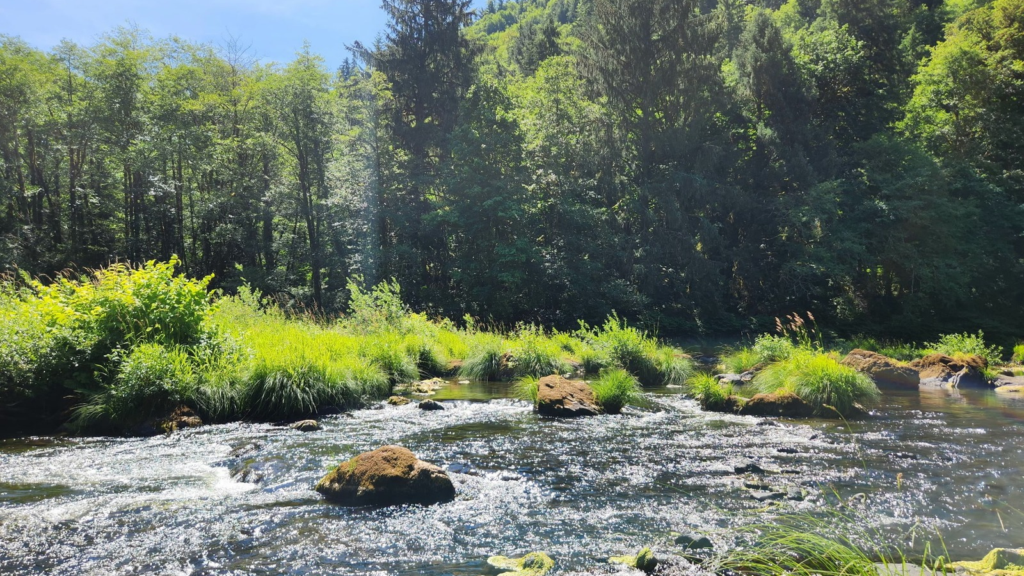
As I’ve entered into fall, I find my toes touching the edges of a river, wide and rushing. I am wishing I could cross over. But I wrestle with memories and changes within my own life. Resentment keeps me locked in time, at the water’s edge, and I am unsure what to let go of and what to carry across.
Often, when we find ourselves unsure, Scripture can be a container to hold our own stories. It can overlay our own narratives, bring deeper truths to light. And so, as I sat with my spiritual director recently, talking about this thing and that like a ping-pong ball thrown in the corners of my mind, she gently said to me, “It sounds like you’re not sure where you are.” The ping-pong ball stopped slowly, and I was left in silence, only to nod with almost a sigh of relief. Yes.
She reads to me the story of Joshua 3. She reads it out loud, slowly, twice. As Eugene Peterson writes in Eat This Book, “Reading may seem to be the first thing, but it is not. Reading is always preceded by hearing and speaking. Language is essentially oral. We learn our language not from a book, not from a person writing words, but from a person speaking them. The written word has the potential to resurrect the speaking voice and listening ear, but it does not insist upon it. The word can just sit there on the page and be analyzed or admired or ignored. Just because we have read it doesn’t mean we have heard it.” This is Lectio Divina. I humble my thoughts to become receptive to the Word spoken to me. I want to hear and get a sense of where I am. I slow my breathing and close my eyes, and my feet are once again at the waters edge. Walter Burghardt defines prayer this way: “a long, loving look at the real.” He even goes on to say, “The real I look at. I do not analyze or argue it, describe it or define it…I do not move around it: I enter into it.”
Immerse yourself in Scripture and you’ll find there are often clearings. A wide open space that once was inhabited by trees or clouds, towns or people, oceans or rivers.
To sit in Lectio Divina is to take notice of these clearings.
Or these “gaps” as Chris Anderson calls them in Light When It Comes. “The Bible is a blended and woven and orchestrated series of fragments and pieces, but with gaps, too, big gaps in between, big jumps sometimes, and these are important, too, just as important, because it’s here, in the spaces, in the silences, we hear God speak.”
//
My spiritual director begins to read, and I pay attention to the words that bring tears or excitement. Like fireflies in the forest, I sit with my back against an old oak facing a clearing, and I wait for the words to light up.
“Joshua said to the priests, ‘Take up the ark of the covenant and pass on ahead of the people.’” (3:6)
“Tell the priests who carry the ark of the covenant: ‘When you reach the edge of the Jordan’s waters, go and stand in the river.’” (3:8)
I’ve sat with this passage for a month now. It was the priests I felt inexplicably drawn to. How they held the ark of the covenant in the middle of the parted Jordan River while the entire nation of Israel crossed over. They held the ark on dry ground and waited until everyone had crossed over. And then they are still there while twelve representatives from each tribe return to the spot where the priests are standing to retrieve a stone from the riverbed and carry it across as a way of remembering what God did for them. The priests do not finish crossing until all of this has been done.
I am left wondering, how long did the priests stand in the middle of the Jordan, while carrying quite literally the presence of God? What is it about the priests I am drawn to?
The priests stand in the middle of the Jordan river at flood stage, and the water is cleared – swept up on either side, like walls of time cut off. In this clearing I am asked to join other priests. Here in the silence, while life wooshes and rushes around us, there is a place we can enter into with all we are carrying. I wonder what the Israelites were carrying with them. Whole stories of belonging, cut off and on the run, carried in bags over their shoulders or knots in their stomachs.
I don’t know what you are carrying, and perhaps your feet are at the edge of time’s river too. Maybe there is a sweet voice asking you to cross. At the edge of pain there is a voice singing with joy, calling you to come further. The point isn’t to get to the other side, but to find the ones waiting for you in the middle, in the clearing, where God’s voice sings. There are priests waiting for you on dry stable ground. Waiting to remind you who you are in God, of your sweetest name – beloved. They will meet you where Christ meets you, in patience and love. There might be parts of your story you are asked to leave in the river. And when you cross over, time will come rushing in and carry them further downstream.
Maybe there are some of us that have told the same story for decades. Whether it be a story about yourself you tell others, or an origin story from your parents, or the story you weaved together to help make sense of a broken relationship. Maybe so much time has rushed downstream we find ourselves as David James Duncan shares in River Teeth, “sharing the same accurate narratives for decades, that we have somehow talked our allotment of stories to death, that no one listens any longer, that when we tell these old tales the room fills with a dark water and our listeners’ eyes glaze. So we stop telling them. We let them decompose. The last filaments of memory become gray mush, the mush becomes mud, the mud washes downriver. New life, and new stories, sprout from the silence.”
//
I think of my grandmother, buried in the sky, while her stories are washed downriver. I’ve only heard a few. Most of them, she kept to herself.
//
Or maybe you are being asked to stand in the clearing beside other priests. You are being asked to do one thing – go on ahead and stand with others in the presence of God and help people cross their own river of time. It might seem simple, but it is not trivial. Often, we can sense God’s leading in our small feelings. Think of it this way, Chris Anderson writes, “But not just compression–expansion: God becomes a child in the womb of a young girl, and the child is born and the child becomes a man, and when that man dies and when he rises again, the fire that breaks from him then, as Gerard Manley Hopkins puts it, is ‘a billion times told lovelier.’ From the tiniest seed grows the mustard tree, the largest of all trees. From the wheat that swells as we sleep comes the harvest, ‘some a hundredfold, some sixty, some thirty.’”
Our ordinary and real stories become expansive in the great clearing of God.
//
At the end of the summer, when my patio has been prepared with the proper grain of rock and dug to the proper depth, I start carrying back and laying down the dug-up flagstones. They are heavy and awkward, but some are small and require more attention for placement. I have dug up memories from living in this house and sharing it with so many people. Many have stayed and passed through. And now I lay down these same stones on a better foundation. One that will hopefully be a dry and steady place of crossing over into a clearing set apart within the river of time. I’ll be there with my candle lit, standing on dry ground waiting for you, with the great High Priest who will stay until everyone has crossed over.